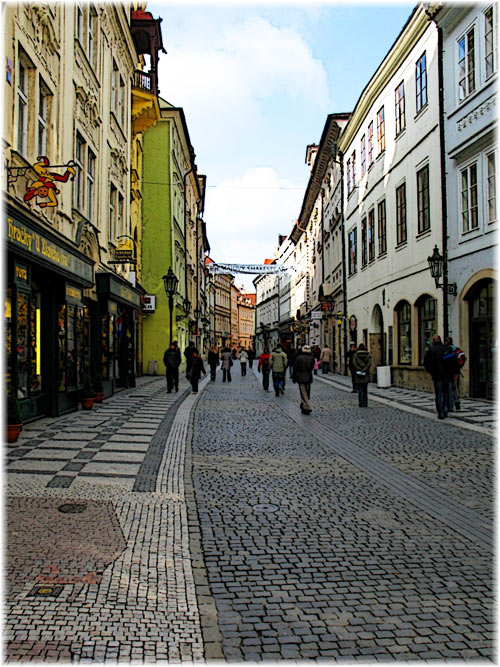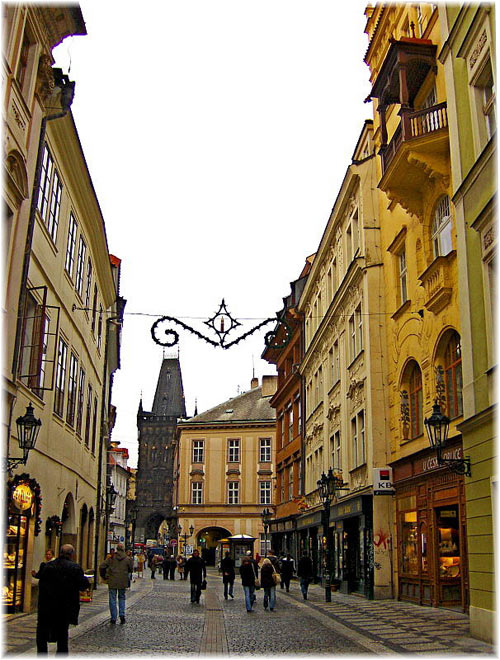


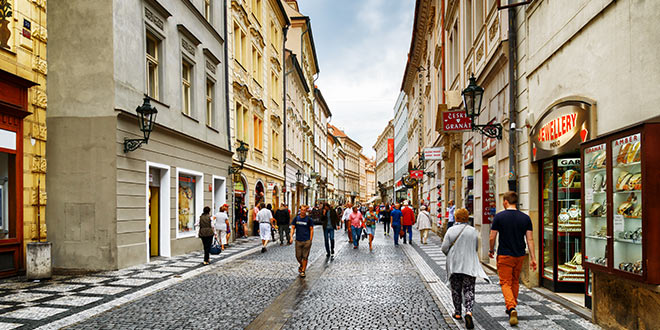
Celetná Street (Celetná ulice) is one of the oldest and most atmospheric streets in Prague’s Old Town. It links the Old Town Square with the Powder Tower and forms one of the key sections of the historic Royal Route.
The name Celetná is traditionally connected with calty, plaited bread rolls that were once baked or sold in this area in the Middle Ages. Today, the street is a busy pedestrian route with historic houses, cafés, shops, galleries, theatre, hotels and architectural details hidden above the doorways.

Part of the Royal Route
Celetná Street was part of the ceremonial Royal Route followed by Bohemian kings on their way to coronation. The route traditionally led from the Powder Tower through Celetná Street, across Old Town Square, through Karlova Street, over Charles Bridge, through the Lesser Town and up to Prague Castle and St Vitus Cathedral.
Visitors walking from the Powder Tower towards Old Town Square are therefore following the same symbolic route once used by royal processions, ambassadors, guilds and city representatives during coronation ceremonies.
Visitor tip: Walk Celetná in both directions if you have time. From the Powder Tower you get the ceremonial approach towards Old Town Square; from the square you get a better view of the street narrowing towards the tower.
Historic Houses and House Signs
Celetná is lined with architecturally and historically important houses. Many have old house signs, names and façades that preserve layers of Romanesque, Gothic, Renaissance, Baroque and later rebuilding.
Among the traditional house names connected with the street are At the Three Kings, At the White Lion, At the Black Sun, At the Vulture, At the White Peacock and At the Golden Angel.
Some of the oldest parts of the houses are hidden underground. Romanesque and Gothic cellars survive beneath many buildings, partly because the street level of Old Prague rose over the centuries.
House of the Black Madonna
The most famous modern architectural landmark on Celetná is the House of the Black Madonna at Celetná 34 / Ovocný trh 19. Designed by Josef Gočár and completed in 1912, it is one of the most important examples of Czech Cubist architecture.
The building is now managed by the Museum of Decorative Arts in Prague and houses an exhibition devoted to Czech Cubism. Prague City Tourism describes it as a masterpiece of Czech Cubist architecture, and the Museum of Decorative Arts lists current opening hours as Tuesday 10:00–20:00, Wednesday to Sunday 10:00–18:00, closed Monday.
The first floor is home to Grand Café Orient, a restored Cubist café and one of the most unusual café interiors in Prague.
Kafka, Theatre and Cultural Life
Celetná Street also has literary and cultural connections. The young Franz Kafka lived for a time at the House at the Three Kings, and the street appears in the wider geography of Kafka’s Old Town Prague.
At Celetná 17 is Divadlo v Celetné, an independent theatre associated with the Kašpar theatre company. It remains an active cultural venue with a regular programme.
Many historic buildings in Celetná now house hotels, cafés, shops, restaurants and cultural venues. This makes the street lively throughout the day, though it can become crowded because it is part of the main walking route between Old Town Square and the Powder Tower.
Shopping on Celetná
Celetná has long been a commercial street. Today, visitors will find souvenir shops, crystal and glass shops, jewellery, cafés, galleries and some international brands near the Powder Tower end.
As with many central Prague shopping streets, quality varies. If you are buying Bohemian glass, garnet jewellery, antiques or design objects, choose carefully and compare prices rather than buying from the first shop you see.
Architectural Sights on Celetná Street
- House at the Black Madonna (Dům U Černé Matky Boží), Celetná 34 / 569 – Czech Cubist architecture by Josef Gočár.
- Menhart House (Menhartovský dům), Celetná 17 / 595 – home of Divadlo v Celetné.
- Caretto-Millesimo Palace, Celetná 13 / 597 – historic palace with Baroque elements.
- Hrzánský Palace, Celetná 12 / 558 – one of the important palace buildings on the street.
- House At the White Peacock (U Bílého páva), Celetná 10 / 557.
- House At the Black Sun (U Černého slunce), Celetná 8 / 556.
- House At the White Lion (U Bílého lva), Celetná 6 / 555.
- House At the Three Kings (U Tří králů), Celetná 3 / 602 – associated with Franz Kafka.

Visiting Information
Location: Celetná Street, Prague 1 – Old Town.
In Czech: Celetná ulice.
Route: Between Old Town Square and the Powder Tower.
Best for: Royal Route history, house signs, Gothic and Baroque houses, House of the Black Madonna, Grand Café Orient, shopping and Old Town walks.
Access: Public pedestrian street, accessible at any time.
Getting there: Walk from Old Town Square, Můstek, Náměstí Republiky, the Powder Tower or Municipal House.
Nearby sights: Old Town Square, Powder Tower, Municipal House, House of the Black Madonna, Estates Theatre, Karolinum and Ovocný trh.
Royal Route information: The Royal Route on Prague City Tourism.
House of the Black Madonna information: Museum of Decorative Arts – House at the Black Madonna.
Divadlo v Celetné: Divadlo v Celetné Official Website.
Why Celetná Street Is Worth Visiting
Celetná Street is more than a tourist passage between two landmarks. It is a concentrated piece of Prague history: medieval trade, royal processions, Romanesque cellars, Baroque house signs, Kafka connections, Cubist architecture and modern city life all meet in one short street.
For first-time visitors, it is part of the classic Old Town route. For repeat visitors, it rewards a slower look above the shopfronts, where the old house names, portals and architectural details still tell the story of Prague’s past.