

Planning a trip to Prague and wondering about money, tickets, taxis or the Castle? We collected the questions visitors ask most often on travel forums and in search, and answered each one with facts checked against official sources in October 2026. Prices and rules do change, so for anything critical, follow the source links or our detailed guides.
Before You Go: Entry Rules and Planning
Czechia is in the Schengen area. EU citizens only need a valid ID card or passport. Visitors from the UK, the US, Canada, Australia and many other countries can stay without a visa for up to 90 days in any 180-day period, and earlier days spent anywhere in Schengen count towards that limit. UK travellers’ passports must be less than 10 years old on arrival and valid for at least 3 months after the day they leave. See our tourist visa guide for more detail.
Not yet. As of late October 2026 ETIAS, the EU’s online travel authorisation for visa-free visitors, is not running and no start date has been announced. The EU has said it will give several months’ notice. When it launches, the fee is expected to be €20, with under-18s and over-70s exempt. Be wary of websites already offering ETIAS applications for a fee, because there is nothing to apply for yet.
The EU Entry/Exit System has been fully running since 10 April 2026. It replaces passport stamps for non-EU visitors on short stays. The first time you enter, your passport is scanned and your fingerprints and photo are taken, so allow a little extra time at the airport. Your record then stays valid for three years, and later crossings should be quicker. EU citizens are not affected.
Three full days is the answer most travellers and locals give. That is enough for Prague Castle, the Lesser Town, Charles Bridge, the Old Town and the Jewish Quarter at an unhurried pace. With four or five days you can add a day trip such as Kutná Hora or Karlštejn. Two days is enough for the highlights if you plan well. Our two-day itinerary shows how to fit the main sights in.
May, June and September usually give the best balance of mild weather and manageable crowds. July and August are the warmest months, with average highs around 26°C, and also the busiest. December is popular for the Christmas markets. January and February are the coldest and quietest months, when hotels are often cheapest. See our guide to the best time to visit Prague.
Winters are cold rather than harsh. From December to February average daytime highs in the city centre are around 4–6°C and nights hover around freezing. Snow does fall, mostly between December and February, but the yearly total is modest and it rarely stays long in the centre. Bring warm layers and shoes with good grip for icy cobbles. More in our guide to Prague’s winter weather.
Money, Prices and Tipping
The currency is the Czech crown (koruna, CZK), and Czechia has no date for joining the euro. Some shops, restaurants and attractions in the tourist centre take euro notes, but the rate is usually poor and change comes back in crowns. You will almost always pay less by using a card or paying in crowns. See our page on Czech currency.
On 29 October 2026 the Czech National Bank’s official rates were about CZK 24.3 for €1, CZK 29.1 for £1 and CZK 21.9 for US$1. Rates change every working day, and exchange offices and card providers add their own margin, so treat these as a guide rather than what you will actually get. The CNB publishes the current rates daily on its website.
Cards, including contactless phone payments, are accepted almost everywhere: hotels, restaurants, shops, museums and the ticket machines on trams and buses. A few small pubs, market stalls and public toilets still only take cash, so it is worth carrying a small amount of crowns. You do not need to change a large sum before you travel. More in our guide to using cards in Prague.
Use cash machines that belong to a bank, ideally inside or beside a branch. Independent ATMs in tourist areas, such as the yellow-and-blue Euronet machines, often charge more. When a cash machine or card terminal offers to charge you in pounds, euros or dollars, decline and choose crowns (CZK). Its own conversion rate is usually worse than your bank’s. See our guide to ATMs in Prague.
Never change money with people on the street, as the notes are often fake. At an exchange office, ask exactly how many crowns you will get before handing over your money. Czech law lets you cancel an exchange of up to the equivalent of €1,000 within three hours at the same office, free of charge, and the office must refund you. Our guide to the best exchange rates in Prague has more tips.
Tipping is customary but not compulsory. In restaurants, around 10% is normal for good table service, and in pubs people often just round up the bill. Czechs usually tell the server the total they want to pay, including the tip, when they hand over cash or a card, rather than leaving coins on the table. If a card terminal shows a tip screen, the tip is optional. See our tipping guide.
Normally it is not. Some restaurants in tourist areas add a service charge. The Czech Trade Inspection Authority treats a charge the customer was not told about in advance as a breach of consumer law. Always read the bill, check for extras such as bread or cover charges you did not order, and ask for anything unexpected to be removed. Our page on overcharging in restaurants explains what to look out for.
Prague is still cheaper than London, Paris or Vienna for most visitors, but it is no longer a bargain city. Prices on and around Old Town Square, Charles Bridge and the Castle can be far higher than in ordinary neighbourhood pubs and restaurants a few tram stops away. Public transport is good value, and many of the best views are free. See Is Prague expensive? and our low-budget tips.
Prague charges a local accommodation fee of CZK 50 per person per night. Guests under 18 and a few other groups are exempt. Hotels and apartments collect it, and it is not always included in the price shown when you book, so expect to pay it at check-in or check-out. Proposals to raise it have been discussed, but as of October 2026 the rate is still CZK 50.
Getting from Prague Airport to the City
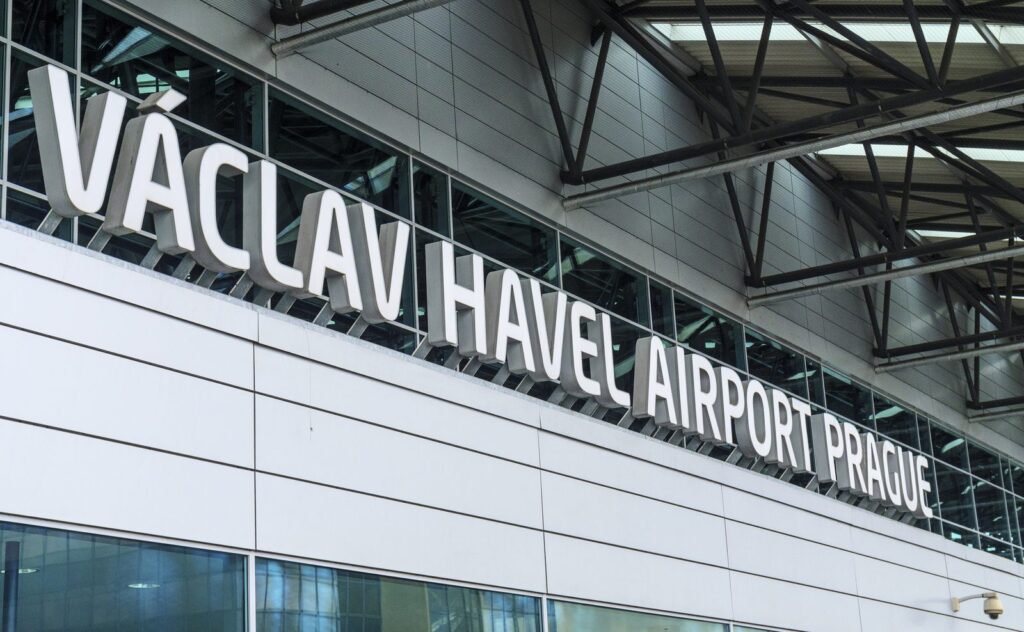
Václav Havel Airport is roughly 18–20 km from the centre. The cheapest way in is trolleybus 59 to Nádraží Veleslavín (metro line A) or bus 100 to Zličín (metro line B), then the metro into town. Both run frequently from early morning until late evening, and the whole journey takes roughly 35–45 minutes. The Airport Express (AE) bus goes to the main railway station. More in our airport guide.
Buy a 90-minute ticket: CZK 46 in the PID Lítačka app, CZK 50 on paper or CZK 55 by SMS. It covers bus 59 or 100 plus the metro and a tram transfer. You can buy tickets at the DPP desks in the arrivals halls (Terminal 1 from 7:00 to 21:00, Terminal 2 from 9:00 to 21:00), from machines that mostly take cards, or in the app. Stamp a paper ticket when you board.
The Airport Express runs from the terminals to Praha hlavní nádraží, the main railway station on metro line C, in about 35–45 minutes. Since 1 January 2026 it has its own fare of CZK 200, double the old price still quoted in many guides. Ordinary PID tickets, including 24- and 72-hour tickets, are not valid on it. For most central hotels, bus 59 plus the metro is cheaper and just as quick.
Since 21 October 2026 Prague’s maximum taxi fares are CZK 70 to get in, CZK 42 per kilometre and CZK 7 per minute of waiting, with VAT included and no extra surcharges. These caps apply to metered taxis on trips within Prague. A metered ride of 18–20 km to the centre therefore costs up to roughly CZK 830–910, plus any waiting time. App rides show a fixed price before you book. See our taxi guide.
Yes. Uber is the airport’s official taxi partner, with pick-up directly outside the Terminal 1 and Terminal 2 arrivals halls around the clock. You can book in the Uber app, at self-service kiosks (card only) or at staffed desks open from 7:00 to 21:00 (card or cash), and you give the driver a six-digit PIN. Bolt also offers airport rides in its app. Ignore drivers touting for business in the arrivals hall.
The metro stops running around midnight. After that, night buses 907 and 910 leave from Terminal 2 about every 30 minutes and take ordinary PID tickets. They link with Prague’s night trams and buses and reach the centre in under an hour. If you have heavy luggage or a late arrival, a pre-booked transfer, Uber or Bolt is simpler. See our page on airport transfers.
Public Transport and Taxis
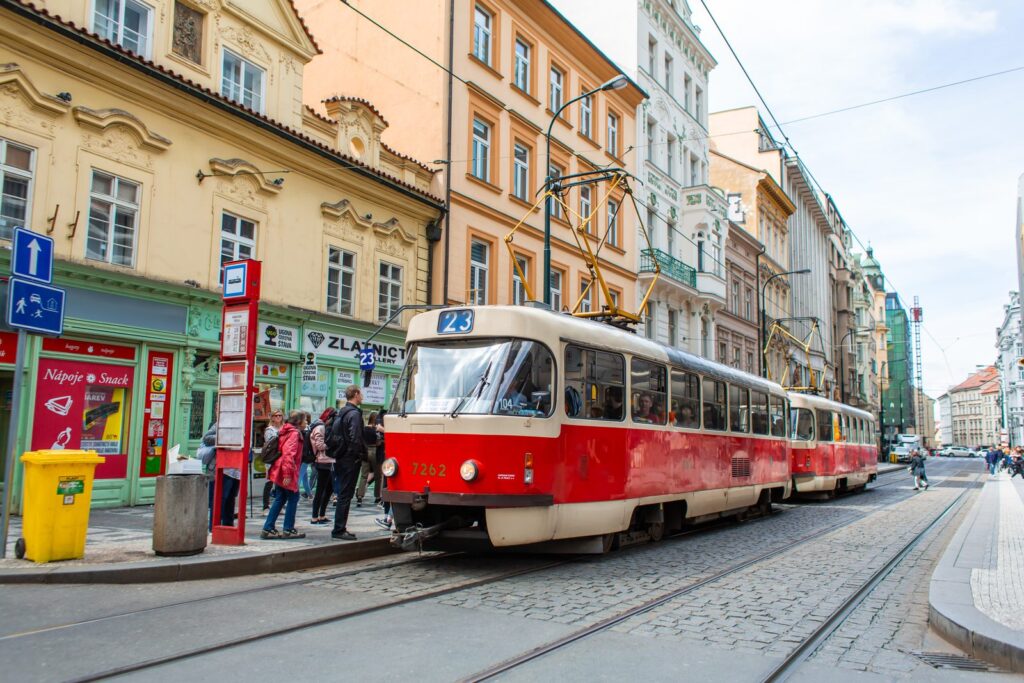
Prices since 1 January 2026 (app / paper): 30 minutes CZK 36 / 39, 90 minutes CZK 46 / 50, 24 hours CZK 140 / 150 and 72 hours CZK 340 / 350. Tickets are valid on the metro, trams, city buses and ferries, and allow unlimited changes within their time limit. Tickets bought in the PID Lítačka app are slightly cheaper. See our full guide to Prague public transport tickets.
If you plan to take three or more rides a day, a 24-hour ticket (CZK 140 in the app) or 72-hour ticket (CZK 340) usually works out cheapest and saves thinking about time limits. If you mostly walk, buy 30- or 90-minute tickets as you need them. The 24- and 72-hour tickets also cover the Petřín funicular and one large suitcase. More in our public transport guide.
Yes. Trams have a ticket terminal by the middle door, and city buses and trolleybuses have one by the second door. They take contactless cards and phones only and sell 30-minute, 90-minute and 24-hour tickets, valid from the moment of purchase. There are no terminals inside metro trains, so buy before you go down, from a machine or in the app. There is no tap-in, tap-out system. See our tram guide.
Paper tickets must be stamped once in a yellow validator, on board trams and buses or before you enter the metro’s paid area. App tickets become valid one minute after you activate them, so activate before boarding. Tickets bought at an on-board terminal need no stamping. There are no barriers, but plain-clothes inspectors check tickets often. Read our page on avoiding a fine.
Since 1 January 2026 the penalty in Prague is CZK 1,200 if paid on the spot, CZK 1,500 if paid within 15 days and CZK 2,000 after that. An unstamped paper ticket counts as no ticket. If you hold a valid pass but cannot show it, you can prove it later for a CZK 50 fee. On trains beyond the city, in the Central Bohemian Region, the fines are higher. See our guide to travelling without a ticket.
Within Prague, children under 6 travel free with someone over 10, and children aged 6 to 10 ride free without proof. Children aged 10 to 15 ride free with photo ID showing their age, but without it they pay full fare. Passengers aged 65 and over travel free with ID showing their age. A pram with a baby is free too. More on our page about children’s travel.
Luggage up to 25 × 45 × 70 cm travels free. Anything bigger, such as a large suitcase, needs a luggage ticket: CZK 25 on paper or CZK 23 in the app. If you hold a 24-hour or longer ticket, one large item travels free. Prams carrying a child, and dogs on a lead with a muzzle, also travel free in Prague.
The metro runs from about 5:00 until around midnight. After that, night trams (lines 91 to 99) run roughly every 30 minutes, and they all meet at Lazarská in the New Town, which makes changing easy. Night buses cover outer districts. Ordinary tickets are valid at night. Timetables changed in late October 2026, so check the PID app for current night routes. See our metro guide.
Yes, both operate across Prague, and Uber is also the official taxi service at the airport. The apps show the price before you confirm, which removes the risk of a rigged meter. Hailing a taxi in the street in tourist areas has a long record of overcharging, so if you want a traditional taxi, book one by phone or app from a known company. More in our taxi guide.
Since 21 October 2026 metered Prague taxis may charge no more than CZK 70 to get in, CZK 42 per km and CZK 7 per minute of waiting. Check that the meter is running and the rates are shown on the car. Avoid unmarked cars and drivers waiting at tourist hotspots. The safest choices are a ride-hailing app or a reputable taxi company. See Ripped off by Prague taxis.
Yes. The funicular up Petřín Hill reopened with new cars on 22 September 2026 after about two years of reconstruction. It runs daily from 7:00 to 22:15, roughly every 10 minutes, and no longer stops at Nebozízek on the way down. A single ride costs CZK 100, or CZK 90 in the app. 30- and 90-minute tickets are not valid, but 24- and 72-hour tickets and the Prague Visitor Pass are. Under-15s and over-65s ride free. See our funicular page.
The official city pass costs CZK 2,700 for 48 hours, CZK 3,300 for 72 hours and CZK 3,900 for 120 hours (adult prices). It includes all Prague public transport, the airport trip both ways, and free or discounted entry to more than 70 sights. It pays off if you plan to visit several paid attractions each day. If you mainly want to walk and see the outside of things, a 72-hour ticket is better value. See our Visitor Pass guide.
Safety and Scams
Yes. Prague is generally a safe city, and violent crime against visitors is rare. The US State Department rates Czechia at Level 1, the lowest level, and UK advice focuses on petty crime. The real risks are pickpocketing in crowded places, overcharging taxis and money-exchange tricks. Normal city sense, such as watching your bag and avoiding street deals, goes a long way. See our safety guide.
UK government advice names the airport bus and metro routes, the trams up to Prague Castle, and the main tourist areas. Take particular care in the crowds on Charles Bridge, under the Astronomical Clock and at the Christmas markets. Keep phones and wallets in a front or zipped pocket, wear bags in front of you in crowds, and be wary of anyone who jostles you as you board. More in our pickpocket guide.
The usual ones are street money changers handing over fake or worthless notes, fake plain-clothes ‘police’ asking to check your wallet, taxis with rigged fares, and ATMs or card terminals pushing a poor conversion rate. Real Czech police do not ask to inspect your currency. If in doubt, offer to go to a police station or call 112. Also check restaurant bills for extras. See our page on scams in Prague.
Generally yes. Many women travel alone to Prague and find the centre lively and well lit into the evening, with good public transport. Take the usual precautions: keep an eye on your drink, as UK advice warns about drink spiking in bars and clubs, use a ride-hailing app late at night rather than street taxis, and stick to busy streets. Our safety guide has more practical advice.
Dial 112, the European emergency number. It is free, works from any phone even without a SIM card, and operators can handle calls in English. You can also call 155 for an ambulance, 150 for the fire service, 158 for the state police and 156 for the city police. To report a theft for insurance purposes, go to a police station. See our list of police stations.
Prague Castle and Other Sights
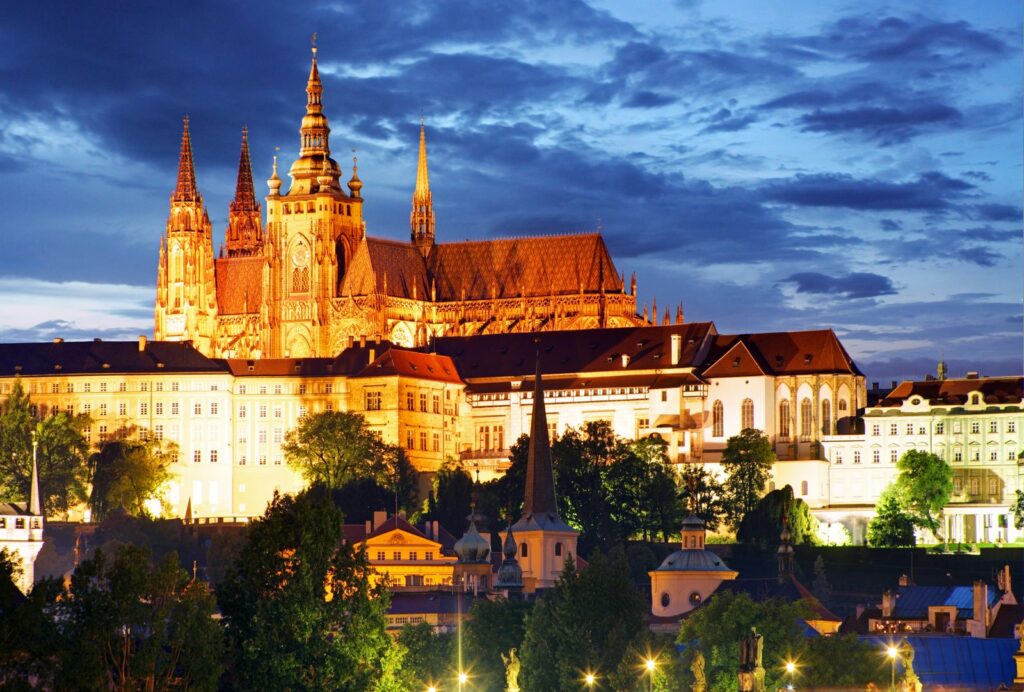
Yes, the castle complex itself is free. You can walk through the courtyards, see the outside of St Vitus Cathedral and enjoy the views daily from 6:00 to 22:00, all year. You only need a ticket to go inside the historic buildings, such as the cathedral interior, the Old Royal Palace and Golden Lane. See our walk through the castle courtyards and our main Prague Castle guide.
The main ‘Basic Tour’ ticket costs CZK 450 for adults, CZK 300 reduced and CZK 950 for families. It covers the Old Royal Palace, St George’s Basilica, St Vitus Cathedral, and Golden Lane with Daliborka Tower, and is valid for two days with one entry to each. The buildings are open daily from 9:00 to 17:00. Check the official site before you go, as state events can close parts. See our castle tickets guide.
The cathedral is open to visitors Monday to Saturday from 9:00 to 17:00, and on Sundays from 12:00 to 17:00 because of morning masses. Last entry is 20 minutes before closing, and visits pause during services. Entry to the main part of the cathedral needs the castle ‘Basic Tour’ ticket. Read more about the cathedral and its entry fee.
The guard changes every hour from 9:00 to 18:00 at the main castle gates. The big ceremonial changing, with a fanfare and flag ceremony, takes place daily at 12:00 noon in the first courtyard. Arrive 15–20 minutes early for the noon ceremony if you want a good view, as it gets very crowded in summer. More in our Prague Castle guide.
Yes, but it is quicker than it used to be. Most of the fixed security frames at the entrances were removed in 2023, and staff now make random checks. If you refuse a check, you will not be let in. Large bags and suitcases are discouraged, so leave luggage at your hotel. Read more about security checks at Prague Castle.
The apostles appear in the windows above the clock every hour, on the hour, from 8:00 to 23:00. The show is short, so arrive a few minutes early and watch your pockets in the crowd. To see it from above, the Old Town Hall tower costs CZK 350 for adults, with 50% off in the first hour after opening. See our page on the Astronomical Clock.
Charles Bridge is free and open day and night. From mid-morning until late evening it is packed, especially from spring to autumn. For photos without crowds, go at sunrise or before about 8:00, or late at night. Winter mornings are the quietest of all. Hold on to your bag, as the bridge is a well-known pickpocket spot. Learn more about Charles Bridge and its statues.
The Jewish Museum’s synagogues and the Old Jewish Cemetery close every Saturday and on Jewish holidays. On other days one ticket (CZK 600 for adults) covers all the open museum sites and is valid for three opening days. The Old-New Synagogue is run separately by the Jewish Community and may need its own ticket. Plan your visit with our Jewish Quarter guide.
Yes. The National Museum holds free-entry days at its main buildings several times a year. The last one in 2026 is Sunday 6 December. On these days entry is first come, first served, and queues can be long. Some branches and special exhibitions are not included. Prague Castle’s courtyards, Charles Bridge and many churches are free every day. See our page on the National Museum.
Food, Drink and Local Rules
Yes. Prague’s water company confirms that tap water is safe to drink throughout the city and meets Czech drinking-water standards. Restaurants usually serve bottled water by default, so ask for tap water (kohoutková voda) if you want it. Some places may charge a small amount for it. Refilling a bottle at your hotel saves money.
Classic dishes include svíčková (beef in a creamy vegetable sauce with dumplings), guláš (goulash), roast pork with dumplings and sauerkraut, and smažený sýr (fried cheese). Try chlebíčky, small open sandwiches, for a snack. Lunch menus (polední menu) in ordinary restaurants are often the best value. Our guide to Czech traditional food and the Czech menu explainer tell you what to order.
Not really. The sugar-coated spit cake sold all over the Old Town has roots in Hungarian-speaking Transylvania and in Slovakia. It only became common in Prague in recent decades, largely as a tourist snack, and Czech media and guides have openly called the ‘old Bohemian tradition’ label a myth. Enjoy one if you like it, but do not expect a local speciality. Our street food guide has alternatives.
Not everywhere. Since 2022 Prague has banned drinking at more than 1,000 public places, including playgrounds, areas near schools and hospitals, and within 100 m of metro entrances. On the riverbanks, including Náplavka, drinking is banned from midnight to 9:00. Carrying an open drink counts. Rules are relaxed on 31 December and 1 January. The legal age for buying alcohol is 18. Read our page on public drinking.
No. Smoking is banned inside restaurants, pubs, bars and cafés, although many have outdoor terraces where it is allowed. Smoking is also banned at public transport stops, in shelters and on platforms. E-cigarettes are not banned inside venues by law, but each venue can set its own rules, so ask first. You must be 18 to buy tobacco. See our page on smoking rules.
Partly, and only for personal use. Since 1 January 2026 adults aged 21 and over may carry up to 25 g in public, keep up to 100 g at home and grow up to three plants at home without committing a crime. Larger amounts are still punished. Selling cannabis for recreational use remains illegal, so ‘cannabis shops’ and street dealers are not legal sources. Read more in our guide to Czech drug laws.
Holidays, Christmas and Opening Hours
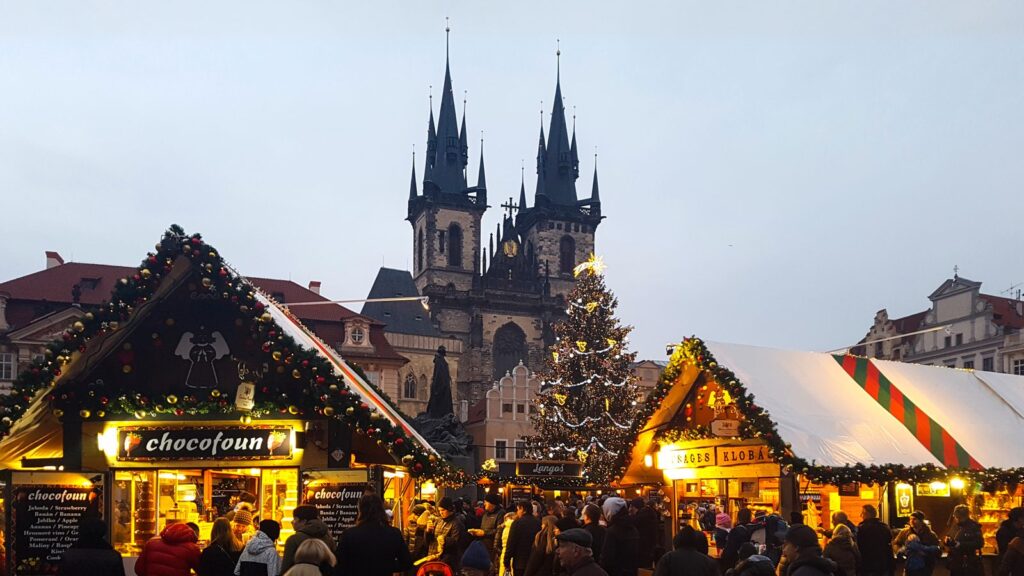
The main Christmas market on Old Town Square opens on Saturday 28 November 2026 and runs until 6 January 2027, with a 23-metre spruce as its tree. Wenceslas Square usually hosts a market over a similar period, but its 2026 dates and the opening hours had not been officially confirmed by late October. Smaller markets appear across the city. See our guide to Prague Christmas markets.
Yes. Czech law does not restrict Sunday trading, so supermarkets, shopping centres and most shops in the centre open on Sundays, often with shorter hours. Restaurants, cafés and pubs open as usual. The exceptions are certain public holidays, when larger shops must close. Some smaller family businesses and offices close at weekends. More on business hours in Prague.
Shops larger than 200 m² must close on 1 January, Easter Monday, 8 May, 28 September, 28 October, 25 and 26 December, and from noon on 24 December. Small shops, petrol stations, pharmacies and shops at airports and railway stations may stay open. Other public holidays are Good Friday, 1 May, 5 and 6 July and 17 November, when large shops may open. See our list of public holidays.
Christmas Eve (24 December) is the main Czech celebration. Large shops close at noon, and many restaurants close early or stay closed that evening, so book ahead. The Prague Castle buildings are closed on 24 December, but the grounds stay open. Large shops also stay closed on 25 and 26 December. Read about Czech Christmas traditions and Christmas in Prague.
The city does not hold an official fireworks display. Under rules adopted in 2026, private fireworks are banned all year, including on New Year’s Eve, in Prague 1, Prague 2 and most other districts, which covers the whole historic centre. In the remaining districts they are only allowed from 17:00 on 31 December to 2:00 on 1 January. Sky lanterns are banned everywhere. See New Year’s Eve in Prague.
Practical Information
Czech is the official language, but you can get by in English in hotels, restaurants, shops and attractions in the centre, and most younger people speak it. Outside the tourist areas and with older people, English is less common. A few words go a long way: dobrý den (good day), děkuji (thank you) and prosím (please). Locals appreciate the effort. See our Czech phrases guide.
Czechia uses 230-volt, 50 Hz electricity with Type E sockets: two round pins and an earth pin on the socket. European two-pin plugs (Types C and E/F) fit. Visitors from the UK, Ireland, the US and Australia need an adapter. Most phone and laptop chargers handle 230 V, but check older US hairdryers and other appliances before plugging them in. See electricity and adapters.
EU and EEA mobile users can use calls, texts and data at home prices under EU ‘roam like at home’ rules. UK networks are not covered, and most now charge for EU roaming, so check your plan before you travel. A travel eSIM or a local prepaid SIM is a cheap alternative for longer stays. Free Wi-Fi is common in cafés and hotels. See our page on phones in Prague.
Partly. Cobblestones, steep streets and historic buildings make the old centre hard going. Public transport is better: most of the 61 metro stations have lifts, low-floor trams run on all daytime tram lines, and city buses are low-floor. The PID and DPP journey planners mark step-free stops and vehicles. The Petřín funicular is not accessible. See our guide for disabled and wheelchair travellers.
Yes. Children under 10 travel free on Prague public transport, and children aged 10 to 15 travel free with ID showing their age. Prams travel free too. Family favourites include Prague Zoo, Petřín Hill, river boat trips, the Toy Museum and the many playgrounds in the parks. Many attractions offer family tickets. See our guide for families with children and our page on Prague Zoo.
Prague City Tourism runs official visitor centres at the Old Town Hall, at Na Můstku at the bottom of Wenceslas Square, at Prague Castle and at Petřín Tower. They give free advice and sell the Prague Visitor Pass. You can also phone the info line, +420 221 714 714 (Monday to Friday, 9:00 to 17:00), or email [email protected]. See our list of useful Prague travel links.
Yes, if you use Czech motorways. Since 1 January 2026 an electronic vignette for a car costs CZK 230 for one day, CZK 300 for 10 days, CZK 480 for 30 days or CZK 2,570 for a year. Buy it only on the official edalnice.gov.cz website, as copycat sites charge extra. Headlights must be on at all times, and the drink-drive limit is zero. See our guide to Czech motorway rules.
Day Trips from Prague
The most popular are Kutná Hora (the Bone Church and St Barbara’s Cathedral), Český Krumlov (a fairytale old town, best with an overnight stay), Karlštejn Castle, the Terezín memorial, the spa town of Karlovy Vary, and Dresden across the German border. Most are easy by train or bus without a tour. Our guide to excursions from Prague compares them.
Trains run from Praha hlavní nádraží, some direct and others with a change at Kolín, and take about an hour. Trains arrive at Kutná Hora hlavní nádraží, which is in Sedlec near the Bone Church but some way from the historic centre. Local buses or a short train hop take you into town. Check times on the IDOS journey planner before you go. See our Kutná Hora guide.
You can, but it is a long day. Buses from Prague (RegioJet and FlixBus) take about three hours each way, and trains take around 2½ to 3½ hours, usually with a change in České Budějovice. Most people find one night there far more relaxing, and the town is lovely in the evening once the tour groups leave. See getting from Prague to Český Krumlov.
Take the S7 suburban train from Praha hlavní nádraží or Smíchov towards Beroun. It runs about twice an hour during the day and takes around 40 minutes. The line is part of Prague’s integrated PID network, so a PID ticket for the right zones is valid. From Karlštejn station it is an uphill walk of roughly half an hour to the castle. Book castle tours ahead in summer. See our Karlštejn guide.
Direct buses leave from the Nádraží Holešovice bus station (metro line C) and take about an hour to Terezín. Get off in the town centre for the Ghetto Museum, and walk about 15 minutes to the Small Fortress. Allow a full day to see both properly. Check bus times on the IDOS journey planner, especially for the return. Read our Terezín guide and the story of Terezín.