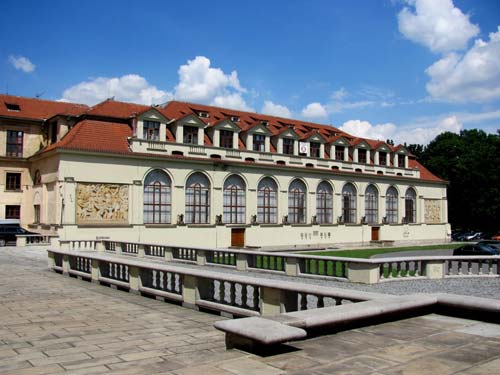


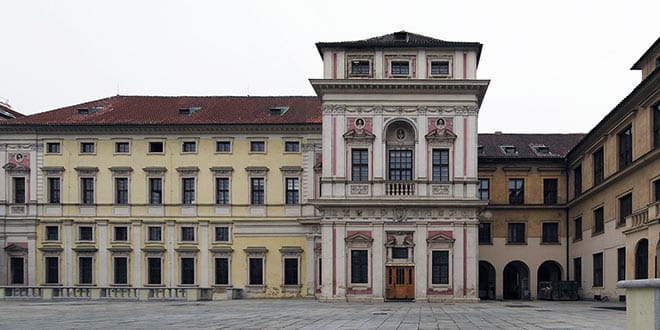
Michna Palace, also known as Tyrš House (Tyršův dům), is one of the largest palace complexes in Prague’s Lesser Town. It stands at Újezd, close to Kampa, Petřín Hill and the Vltava River.
The palace is an important example of early Baroque architecture in Prague, but it is also strongly connected with Czech sport and civic life. Today, the complex is the seat of the Czech Sokol Community, the historic gymnastics and physical-education organisation.

From Renaissance Summer Palace to Baroque Residence
The history of the site goes back to the late 16th century. Around 1580, Italian architect Ottavio Aostalli built a Renaissance summer residence here on land connected with an older Dominican convent.
In 1623, the property was bought by Pavel Michna of Vacínov. He and his son wanted to create a palace that could compete with the nearby Wallenstein Palace, one of the greatest aristocratic residences in Prague.
Architects Francesco Caratti and Pietro Colombo helped transform the complex into a grand palace inspired by Roman noble architecture of the 16th century. The result was a large five-winged residence with a forecourt, inner courtyard, loggias and garden spaces.
Military Use and Later Decline
After its aristocratic period, the palace gradually lost its original function. In 1767, the complex was acquired by the state and used by the military, including as an armoury.
Over time, the building deteriorated. Like many large historic complexes in Prague, it survived through practical reuse rather than careful preservation.
Its modern story began after the creation of Czechoslovakia, when the complex was adapted for the Sokol movement.
Tyrš House and the Sokol Movement
After 1918, the palace complex was converted into a centre for physical education and gymnastics. It became known as Tyrš House, named after Miroslav Tyrš, co-founder of the Sokol movement.
Sokol was never only about sport. It played an important role in Czech civic life, national identity, discipline and community organisation. Tyrš House became one of its most important centres.
The complex contains sports facilities, including four gymnasiums and the oldest indoor swimming pool in Prague. It is also used for conferences, training, representative events and social functions.
Visitor tip: Michna Palace is not normally visited like a standard museum. Look out for special events such as Sokol open days, heritage open days or cultural programmes if you want to see more than the exterior.
Architecture and Atmosphere
From the street, the complex does not immediately reveal its full scale. Behind the façade are courtyards, historic wings, sports halls, garden areas and spaces adapted over several centuries.
The palace reflects several layers of Prague history: Renaissance aristocratic leisure, early Baroque ambition, military use, national revival ideals and modern Czech sporting culture.
This mixture makes Tyrš House different from many other Prague palaces. It is not only a preserved noble residence, but a living institution still used for physical education and public events.
Visiting Information
Location: Újezd 450/40, Prague 1 – Lesser Town.
In Czech: Michnův palác / Tyršův dům.
Current use: Seat of the Czech Sokol Community.
Access: The complex is not open as a regular tourist attraction. Public access is mainly possible during selected events, open days or arranged programmes.
Nearby sights: Kampa Island, Petřín Hill, Memorial to the Victims of Communism, Church of Our Lady Victorious, Lesser Town and the Vltava riverbank.
Getting there: Tram stop Újezd.
Prague City Tourism information: Tyrš House – Michna Palace on Prague City Tourism.
Why Michna Palace Is Worth Noticing
Michna Palace is often overlooked by visitors walking between Újezd, Kampa and Petřín. Yet it is one of Prague’s largest palace complexes and one of the most important buildings connected with the Czech Sokol movement.
Its history stretches from Renaissance gardens and Baroque aristocratic ambition to military use and modern Czech civic life. Even if you only see the exterior, it is worth knowing that behind the walls stands a palace that became a national centre of sport, education and community.