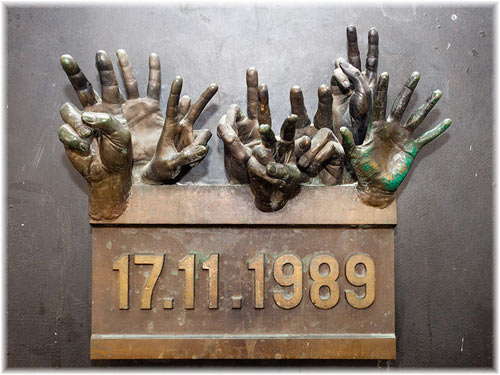


The Velvet Revolution Memorial on Národní třída is one of Prague’s most important modern memorials. A small bronze relief of hands marks the place where communist riot police violently stopped a peaceful student march on 17 November 1989.
This event helped trigger the Velvet Revolution, the non-violent movement that brought down the communist regime in Czechoslovakia within weeks.

What Happened on 17 November 1989
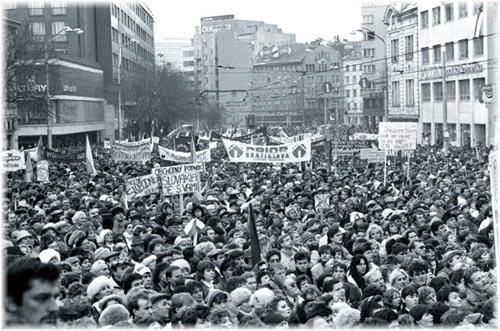
On 17 November 1989, students gathered to mark the 50th anniversary of the Nazi suppression of Czech universities in 1939. The march began at Albertov and continued to Vyšehrad, where participants honoured student Jan Opletal and other victims of Nazi repression.
After the official part of the event, many demonstrators continued towards the centre of Prague. Their route eventually led to Národní třída, where they were blocked and beaten by riot police.
The brutality of the police intervention shocked the public. Students, actors and theatre workers reacted quickly, strikes spread, and civic opposition soon formed around the Civic Forum. The events on Národní třída became the symbolic beginning of the Velvet Revolution.
Historical note: The memorial does not mark the end of the Velvet Revolution. It marks the violent police crackdown that helped start the mass civic movement against communist rule.
The Bronze Hands Memorial
The memorial is a bronze relief called Ruce, meaning Hands. It shows hands making the victory sign and reaching outward, symbolising protest, courage and the desire for freedom.
The relief was created by Otakar Příhoda and Miroslav Krátký. It was first placed in the passage of Kaňka Palace in 1990, soon after the fall of the communist regime.
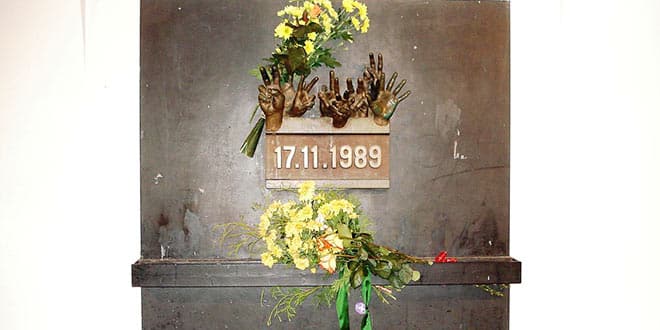
In 2016, the memorial was moved from the passage to the façade of the building, making it more visible from the street. Today it is one of the main places where people come every year on 17 November to light candles and lay flowers.
Why Národní třída Matters
Národní třída was already one of Prague’s important cultural and civic streets, linking the National Theatre area with the city centre. After 1989, it became one of the strongest symbols of modern Czech democracy.
The memorial is small, but its meaning is large. It reminds visitors that the collapse of the communist regime in Czechoslovakia began not with a battle, but with students, flowers, songs, theatre strikes, civic courage and public refusal to accept violence and fear.

Commemorations on 17 November
Every year on 17 November, Národní třída becomes one of Prague’s main places of remembrance. People bring candles, flowers and Czech flags to the memorial.
The date is now a Czech public holiday: Struggle for Freedom and Democracy Day and International Students’ Day. It commemorates both the Nazi repression of Czech students in 1939 and the student-led protests of 1989.
For visitors in Prague on this date, Národní třída is one of the most meaningful places to experience Czech public memory.
Visiting Information
Location: Národní třída, Kaňka Palace / Kaňkův dům, Prague 1 – New Town.
In Czech: Památník 17. listopadu 1989.
Artwork name: Ruce.
Artists: Otakar Příhoda and Miroslav Krátký.
Access: Public memorial, visible from the street at any time.
Admission: Free.
Getting there: Metro B to Národní třída, or tram to Národní divadlo or Národní třída. The memorial is within walking distance of the National Theatre, Wenceslas Square and Jungmannovo Square.
Nearby sights: National Theatre, Café Slavia, Topičův dům, Jungmannovo Square, Franciscan Garden, Wenceslas Square and the Vltava riverfront.
Prague City Tourism information: Národní Street on Prague City Tourism.
VisitCzechia information: Places in Prague Related to the Events of 1989.
Why the Velvet Revolution Memorial Is Worth Visiting
The Velvet Revolution Memorial is not large or dramatic in appearance. Its power comes from what happened here and what followed.
Standing on Národní třída, visitors can remember the students who marched peacefully, the police violence that shocked the country, and the civic movement that ended communist rule in Czechoslovakia. It is one of the most important modern history stops in Prague.