



If you do not want to commit a faux pas right after you get off the plane, read these tips on traditions, etiquette, and how to mingle with local people. Czechs do not have very loud personalities, so be prepared to quieten down, get used to removing your shoes, and say goodbye to everyone when you leave a restaurant. When in doubt, observe what the locals are doing, act accordingly, or use your sense of humour about the situation.
• Watch your volume: people tend to speak quietly in public areas and be annoyed by foreigners who talk loudly in trams or restaurants.
• Though some foreigners describe a lack of warmth or downright rudeness among locals, it is the custom here to maintain a certain amount of distance from people you don’t know very well. Once you’ve spent some time with a person, they are likely to be much more open and friendly. Just be nice, and you will be rewarded.
Tipping
It is usual in restaurants, pubs, cafés and taxis to round the bill to the next 10 CZK or 20 CZK, depending on your satisfaction and the total amount. For example, if your bill is 82 CZK, you might say 90 CZK or 100 CZK. In some restaurants, you might see a note on the bill reading ‘service is not included. If you wish to use %, generally, a 10% gratuity is given, though it is not necessarily expected and by Czech standards, this rate is considered generous.
On Public Transportation
• Let people out of the tram or metro before you enter.
• You will be expected to give up your seat on the tram or metro to elderly or pregnant women and children. For gentlemanly reasons, older men will not take a woman’s seat unless they are very frail. But be careful about whom you stand up: you risk insulting a woman if you offer her your seat before she feels she needs it.
• On escalators, always stand on the right side to let people pass on the left.
Dining Out
• In Prague, it is considered good manners for the man to enter a restaurant or bar before the woman does. This ostensibly keeps her from being eyeballed by the men inside and allows the man to deal with clearing a path and finding a table.
• Service tends to be at the table, even in pubs.
• When waiting for a beer, put a coaster down in front of you so the server can place your mug there. In some pubs, setting down the coaster will automatically get you a beer.
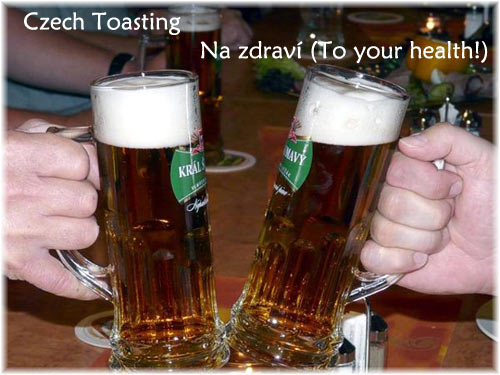
• Toasting is very common. The local ritual is to look into the other person’s eyes, clink glasses, and say Na zdraví (To your health!). Never cross arms with someone else to reach a person on the other side of the table.
• Say bon appetit before starting your meal.
• When leaving a tip, you can give the server the bill’s exact amount and say either “to je dobrý or v pořádku” (that’s fine). You may also leave a tip on the table.
At the Theatre
• Dressing up for the theatre is customary but is no longer a strict rule. You should, however, refrain from wearing trainers. On the other hand, when attending a classical concert or opera, you must be in formal dress.
• Whistling is not considered a positive form of applause: it’s equivalent to booing.
Other
• You may be asked to pay to use a public toilet (usually 5 to 10 CZK), even in some restaurants.
• You are likely to see nudity on beaches or swimming pools and some topless sunbathing in parks. Nude children are considered perfectly acceptable in pool or beach areas.
• If you’re invited into a Czech home, make some flowers for your hosts and take your shoes off inside the door.

For your hosts, take alcohol rather than flowers. Czechs will appreciate it more. 🙂
I never lived there but I did visit once. Although many people do understand and speak a decent amount of English (at least in Praha), remember that not everyone does, and that YOU are the visitor in THEIR home country. I would greet people in Czech and ask how they were, before asking for help. It’s just good manners. Even though the few words in Czech I did attempt to use were often mispronounced, I think the people I encountered appreciated my attempts and would often politely correct me, and then they would continue the conversation in English. So maybe it’s not necessarily a custom or tradition, but just general courtesy and it really did help us to get around and to interact with the people there.
Totally agree except for one part. Do not ask strangers how they are. Not in Czech, not in English. Unlike in the US, for Czechs it is not a rhetorical question and it is not a thing to be asked by a stranger. We ask how people are only when we know them and when we want to know the answer. When you ask a Czech how he is, he will tell you and he will not refrain from complaining if he is not fine.
Very well written! I lived in the Czech Republic for 25 years and I agree with every point. I just want to stress the “Not being loud in public transport” part. This can get people really annoyed…